Why Choose a Patterned Knit Sweater for Wholesale?
Wholesale buyers need more than attractive clothing. They need products that sell, perform, and remain practical across changing seasons. A Patterned Knit Sweater can offer strong visual appeal without relying on loud branding. Its repeating diamonds, stripes, or jacquard motifs create interest from several metres away. That matters on crowded retail racks and online product pages.
Kaffe Fassett, a respected textile and knitwear designer, has often expressed a simple design principle: “Colour is everything.” His view reflects an important wholesale reality. Colour and pattern influence first impressions, customer emotion, and buying decisions. Experienced suppliers also understand the technical side. Yarn composition, stitch density, gauge, and colourfastness affect comfort and long-term value. A beautiful sample can still fail if the sleeves stretch or the pattern loses definition after washing.
Details matter.
For retailers, patterned knitwear can support several price points and customer groups. A subtle Fair Isle-inspired design may suit office wardrobes. A bold geometric style can attract younger shoppers seeking statement pieces. Wholesale orders also benefit from coordinated colour stories, easier merchandising, and repeatable seasonal collections.
Yet the choice is not risk-free. Some patterns age quickly. Others look attractive in photographs but feel too heavy in person. Forecasting demand remains imperfect. That is why responsible wholesale planning includes physical samples, wash testing, clear size grading, and honest communication about production limits. When design ambition meets dependable manufacturing, a Patterned Knit Sweater becomes more than a seasonal item. It becomes a practical investment in texture, identity, and repeat sales.
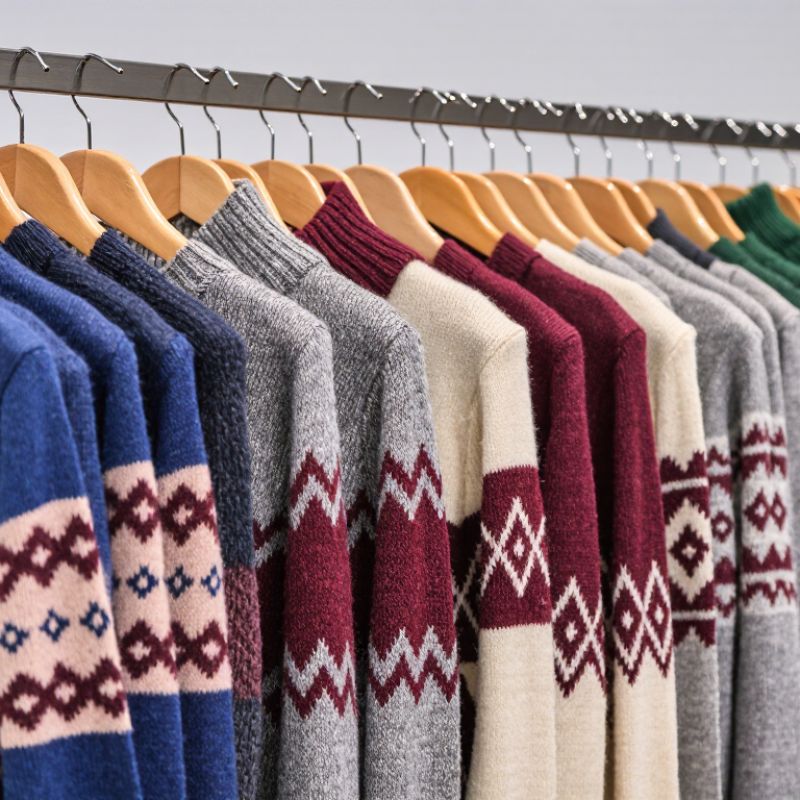
A patterned knit sweater is defined by three technical elements: pattern, gauge, and fiber structure. The pattern is the visible design, such as cables, jacquard motifs, ribs, or geometric repeats. Gauge measures needle density and affects thickness, weight, and drape. A 5-gauge knit feels chunky and warm. A 12-gauge knit looks finer and usually layers more easily. Fiber structure describes the yarn’s material and construction, including wool, cotton, recycled polyester, blends, and twist level.
These details affect wholesale performance. The Textile Exchange Materials Market Report 2024 estimates global fiber production reached 124 million tonnes in 2023. Polyester represented about 59 percent of total output. That scale supports consistent supply, but fiber choice still changes pilling, breathability, recovery, and care needs. The International Wool Textile Organisation reports that wool remains naturally breathable and moisture-regulating. Buyers should test actual samples, not trust fiber labels alone. A soft sweater can still pill badly.
Pattern also influences production risk. Complex repeats require precise tension control and more inspection. Uneven gauge can distort a sleeve or shift a motif by several centimeters. I have seen attractive samples fail because the pattern looked crowded after washing. That mistake is easy to underestimate. Request wash-test results, yarn specifications, finished measurements, and colorfastness records before placing a bulk order. Small details matter. The best wholesale choice balances visual interest with stable construction, repeatable sizing, and a fiber structure suited to the customer’s climate.
Grand View Research projects a 5.6% compound annual growth rate for the global knitwear market from 2024 to 2030. This forecast signals steady commercial interest, not guaranteed sales. For wholesale buyers, patterned knit sweaters offer a practical way to refresh seasonal assortments. Geometric motifs, soft color contrasts, and textured stitches can create shelf impact without relying on heavy decoration. Smaller retailers may also use one sweater across casual, travel, and weekend collections.
In sampling reviews, pattern clarity often influences perceived quality within seconds. A misaligned repeat can make an otherwise attractive sweater look careless. Wholesale teams should examine gauge consistency, yarn recovery, colorfastness, and size grading before confirming larger quantities. Production complexity may also increase lead times, especially when several yarn colors meet in one design. That risk deserves attention. Forecast data cannot replace product testing or local customer feedback.
Tips: Compare three pattern scales before ordering. Request fiber composition and care information. Check measurements after washing, not only before it. Keep initial quantities moderate when testing unfamiliar motifs. A simple tracking sheet can record sell-through, returns, customer comments, and fit issues. Those details make the next buying decision more evidence-based. Mistakes still happen. Careful records make them less expensive.
| Data Dimension | Market Context / Wholesale Relevance | Value | Interpretation |
|---|---|---|---|
| Forecast period | The period used for the knitwear market growth outlook | 2024–2030 | A six-year planning window for assortment, sourcing and replenishment decisions. |
| Reported knitwear CAGR | Compound annual growth rate cited in the market context | 5.6% | Indicates sustained category expansion rather than a single-season demand spike. |
| Indexed market level | Illustrative index using 2024 as the base year | 100 → 138.6 | At 5.6% CAGR, the indexed market level rises by approximately 38.6% by 2030. |
| Pattern visibility | Visual differentiation created through jacquard, stripes, checks, cables or geometric motifs | High | A visible pattern can strengthen product recognition without relying on a logo or brand mark. |
| Seasonal flexibility | Knit sweaters can be styled as standalone tops or layered garments | Multi-season | Layering potential supports use across transitional weather and colder selling periods. |
| Wholesale assortment role | A patterned style can complement solid-color knitwear within the same range | Range builder | Adds texture and visual variety while helping buyers build a balanced collection. |
| Merchandising potential | Patterns provide clear visual merchandising and online thumbnail appeal | Strong | Distinctive knit structures and motifs can make product stories easier to communicate. |
| Planning formula | CAGR-based indexed projection | 100 × (1.056)6 | A transparent planning model; it is not a statement of absolute market revenue. |
Patterned knit sweaters can help wholesale buyers create stronger product differentiation. A plain knit may fit every assortment, but it is easier to compare on price. Geometric motifs, textured stitches, and seasonal color stories give retailers clearer visual reasons to buy. According to The State of Fashion 2025 by McKinsey and The Business of Fashion, global fashion growth is expected to remain modest, at around 2% to 4%. In a slower market, distinctive products can protect attention and reduce direct price competition.
Assortment depth matters, too. A buyer can build one sweater story across crewnecks, cardigans, relaxed fits, and lightweight layers. This supports different budgets and customer preferences without losing visual consistency. Seasonal demand also creates useful timing. Autumn patterns can move from early transitional weather into holiday gifting. However, not every bold design sells well. I have seen attractive samples remain unsold when color choices ignored local buying habits. Reports provide direction, not certainty. Test quantities still matter.
Tips: Start with three pattern scales: subtle, medium, and statement. Offer core neutrals beside one or two seasonal shades. Review sell-through by size and color before repeating an order. Keep fabric weight aligned with the delivery month. A warm sweater arriving too late loses value quickly. McKinsey’s apparel research also highlights increasing consumer value sensitivity, so wholesale pricing should reflect durability, wearability, and merchandising flexibility—not decoration alone.
Why Choose a Patterned Knit Sweater for Wholesale?
Cost and Risk: MOQ, Landed Cost, Lead Time, and Inventory Turnover Metrics
Patterned knit sweaters can create stronger visual appeal, but wholesale success depends on measurable risk. Start with MOQ, not just the unit price. A 500-piece minimum may appear manageable, yet six colorways can create 3,000 slow-moving units. Request a size curve and production sample before confirming bulk quantities. Mistakes happen here.
Landed cost includes yarn, knitting, trims, packaging, freight, duties, inspection, and payment fees. The 2023 UNCTAD Review of Maritime Transport reported that ships carry over 80% of global merchandise trade by volume, showing why freight disruption can affect final pricing. Build at least two freight scenarios. A cheap factory quote is not always a cheap delivered product. I have seen margin plans fail after freight and duty assumptions changed.
Lead time should connect directly with inventory turnover. Track inventory turnover as cost of goods sold divided by average inventory. The faster the turnover, the less cash remains locked in sweaters. The National Retail Federation estimated 2023 retail returns at 14.5% of total U.S. retail sales, or about 743 billion dollars, so fit and product descriptions deserve attention. For patterned knitwear, use limited pilot orders, review sell-through after four weeks, and reorder proven sizes. This approach may reduce volume discounts. Still, it can protect cash flow when forecasts are imperfect.
Cost and risk comparison across MOQ, landed cost, lead time, and inventory turnover
Larger wholesale orders generally reduce landed cost and lead time per unit, while increasing minimum order quantity and inventory exposure. The chart uses an indexed scale so that different units can be compared visually: 100 represents the highest value within the benchmark. The underlying planning figures are shown below.
| Order Scenario | MOQ (Units) | Landed Cost (USD/Unit) | Lead Time (Days) | Inventory Turnover (Times/Year) |
|---|---|---|---|---|
| Small Batch | 300 | 18.40 | 55 | 2.6 |
| Standard Order | 1,000 | 12.80 | 42 | 3.8 |
| Volume Order | 3,000 | 9.90 | 35 | 5.1 |
A patterned knit sweater can improve shelf appeal without changing the core construction. However, wholesale value depends on repeatable quality. AQL 2.5 inspections, commonly based on ISO 2859-1 sampling, help buyers assess defects in a production lot. Inspectors check measurements, stitching, color matching, pattern alignment, pilling, and loose yarns. AQL 2.5 is not a magic shield. It is a sampling method, not a promise that every piece is perfect.
Fiber information also requires careful control. Textile Exchange’s 2024 Materials Market Report recorded 124 million tonnes of global fiber production in 2023. Synthetic fibers represented about two-thirds of output, making accurate fiber identification increasingly important. For many markets, labels must state fiber composition clearly and use approved terminology. The European Union applies Regulation (EU) No 1007/2011, while the United States follows federal textile labeling requirements. Exporters should verify the destination rules, not copy one label everywhere. Small wording errors can create avoidable relabeling costs.
Tips: Request a pre-production sample and a final inspection report. Compare the approved sweater with bulk pieces under neutral lighting. Keep fiber percentages, care symbols, and test records together. Inspectors can miss subtle jacquard distortions. Buyers should review borderline findings instead of accepting every pass automatically. That extra review may reveal recurring tension problems before shipment.
Geometric motifs, textured stitches, and seasonal colors create stronger visual differentiation. Plain sweaters are easier to compare by price. Distinctive designs can attract attention in a slower market. Still, decoration alone does not guarantee sales.
Use one visual story across crewnecks, cardigans, relaxed fits, and lightweight layers. This supports different budgets and customer preferences. Keep colors and patterns connected. The assortment may feel too repetitive if every style looks nearly identical.
Test subtle, medium, and statement patterns. Place core neutrals beside one or two seasonal shades. Small geometric details suit cautious customers. Bold designs need smaller trial quantities.
Match fabric weight with the delivery month. Autumn styles can sell during transitional weather and holiday gifting. A warm sweater arriving late loses value quickly. Timing matters more than many buyers expect.
Begin with limited quantities and review local color preferences. Check sell-through by size and color before reordering. Attractive samples can still remain unsold. Reports offer direction, not certainty.
Inspectors sample production lots for measurements, stitching, color matching, and pattern alignment. They also check pilling and loose yarns. The method helps identify production risks. It does not prove every sweater is perfect.
Compare the approved sample and bulk pieces under neutral lighting. Look for changed measurements, distorted jacquard, and uneven tension. Subtle problems are easy to miss. A final report should not replace personal review.
Fiber percentages, care symbols, and approved wording should match destination requirements. Keep label records with test documents. Do not copy one label everywhere. Small wording errors may cause relabeling costs.
Consider durability, wearability, fabric weight, and merchandising flexibility. A beautiful pattern has limited value if customers rarely wear it. Review borderline inspection findings carefully. Sometimes a “passing” lot still deserves another discussion.
A Patterned Knit Sweater can give wholesale buyers a practical way to build a more distinctive and commercially flexible assortment. Its appeal is shaped by the relationship between pattern design, knitting gauge, and fiber structure, which together influence appearance, warmth, stretch, durability, and production cost. With the knitwear market projected to grow at a 5.6% CAGR from 2024 to 2030, patterned styles can help retailers respond to seasonal demand while offering greater visual variety and stronger shelf differentiation.
For wholesale planning, success depends on balancing design value with operational control. Buyers should evaluate minimum order quantities, landed cost, lead time, and inventory turnover before placing orders, especially when managing seasonal collections. Quality assurance should include AQL 2.5 inspections covering measurements, stitching, color consistency, pattern placement, and finishing. Clear fiber labels and accurate material information are also essential for customer transparency and regulatory compliance.
FUJI