Knit Tank Top manufacturing is becoming more technical, not merely more fashionable. Buyers now examine yarn quality, stitch density, shrinkage, colorfastness, and factory consistency. A soft ribbed tank may look simple, yet its neckline can lose shape after only a few washes. That small failure affects returns, brand trust, and long-term costs.
Textile Exchange’s Materials Market Report 2024 reported that global fiber production reached approximately 124 million tonnes in 2023. It also projects production could approach 160 million tonnes by 2030. This growth increases pressure on manufacturers to manage cotton, recycled polyester, viscose, and blended yarns responsibly. The Global Organic Textile Standard and OEKO-TEX standards also show why chemical control and traceability matter during supplier evaluation. These points help frame our selection of the top 10 Knit Tank Top manufacturers.
The comparison considers production capacity, knitting expertise, sample development, minimum order quantities, quality systems, customization, and export experience. It also examines whether manufacturers can produce lightweight summer tanks, heavy ribbed styles, seamless designs, and private-label collections. Real factory evidence matters. Clear certifications matter more. No ranking is flawless. A supplier that suits a large retailer may frustrate a small startup with high minimums. Conversely, a smaller factory may offer better communication but limited machinery. This guide combines industry evidence with practical sourcing considerations, helping buyers identify manufacturers that balance price, durability, compliance, and reliable delivery.
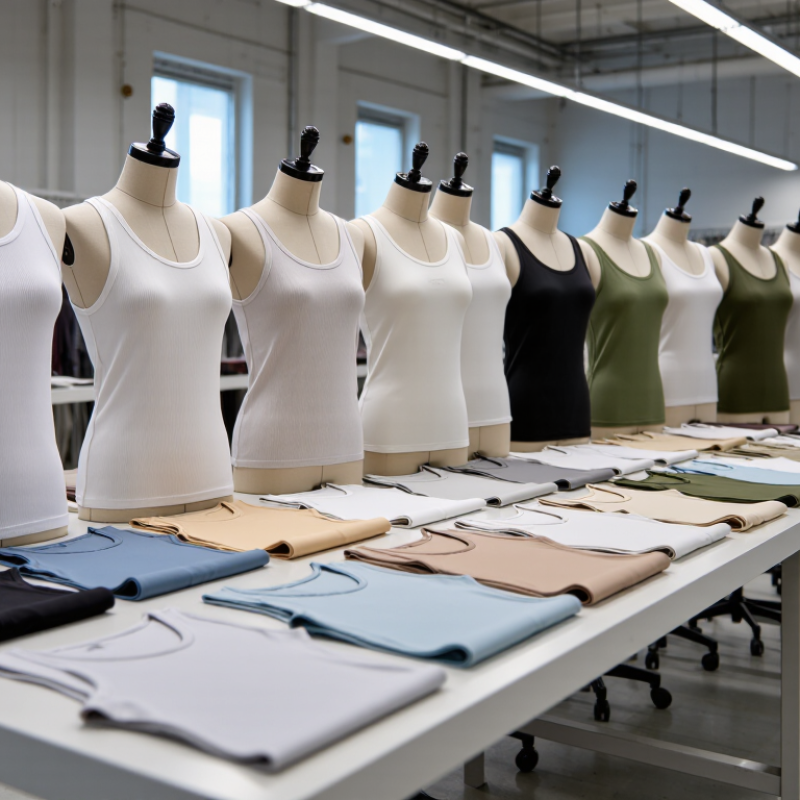
What Are the Top 10 Knit Tank Top Manufacturers?
Knit tank tops are sleeveless garments made from knitted fabric or shaped knitted panels. Their defining feature is looped construction, which creates stretch, softness, and air permeability. The boundary is not always clean. Some factories call lightweight jersey tanks “knitwear,” although they are cut and sewn from fabric rolls.
Classification usually follows several technical details. Construction may be fully fashioned, seamless, or cut and sewn. Fully fashioned tanks form panels with precise knitting, reducing fabric waste. Seamless styles use circular machines and often provide smoother comfort. Cut-and-sew tanks offer flexible shapes and lower sampling costs. Fiber content adds another category, including cotton, viscose, wool, recycled fibers, and blended yarns. Gauge also matters. Fine gauges create smooth summer layers, while coarse gauges produce visible texture and warmth.
Tips: When comparing the top 10 manufacturers, request a physical sample, yarn details, gauge information, measurement charts, and wash-test results. Check shrinkage, color stability, seam strength, and recovery after stretching. Ask how defects are recorded and corrected. A strong supplier should explain these processes clearly, not hide behind attractive photographs. I have found that small measurement differences can change the entire fit. It is easy to overlook this during early development. Evaluate knitting skill, quality control, material traceability, minimum order quantities, and communication speed together. No single factory is best for every tank top category.
Evaluating the top 10 knit tank top manufacturers requires more than comparing prices. Start with product quality, fabric knowledge, and production consistency. Ask for fabric composition, weight, stitch type, and shrinkage results. A reliable manufacturer should explain how cotton, recycled fibers, or blended yarns behave after washing. Samples reveal flaws. Check the neckline recovery, armhole binding, seam strength, and color evenness under natural light.
Production capability also matters. Review the manufacturer’s minimum order quantity, monthly capacity, lead times, and ability to repeat approved samples. Request recent quality-control records and independent test reports when available. These documents should cover colorfastness, dimensional stability, fiber content, and harmful-substance limits. Factory audits can provide useful evidence, but they should not replace direct sample inspection. Details matter.
Communication is another practical test. Strong suppliers answer technical questions clearly and report problems before shipment. Examine their traceability process, from yarn purchasing to packing cartons. Ask how they handle rejected panels, late materials, and corrective actions. A low quotation may hide weak inspection or unstable production. Conversely, higher pricing does not always guarantee better workmanship. The comparison can remain imperfect. Record every promise in writing, then check whether the delivered tank tops match the approved measurements, labels, packaging, and tolerance limits.
A regional view gives more value than a simple list of the top 10 knit tank top manufacturers. China remains strong in large-scale production, offering broad yarn choices, computerized knitting, and flexible color development. Bangladesh is competitive for high-volume orders, especially when buyers provide clear specifications and stable forecasts. Vietnam combines efficient production with improving technical skills, while India is known for cotton expertise and detailed surface textures.
Turkey serves buyers needing shorter shipping routes into Europe. Portugal and Italy often focus on refined finishing, compact production runs, and premium yarn handling. Peru offers experience with soft natural fibers, particularly when warmth and hand feel matter. Southeast Asian producers may provide attractive pricing, but their quality systems can differ widely between factories. That difference matters.
A reliable top-ten assessment should examine factory capacity, knitting gauges, fabric testing, dye consistency, and worker safety procedures. Buyers should request recent production samples, not only showroom pieces. Check shoulder recovery, armhole stretching, seam strength, and shrinkage after washing. Fit still varies. A tank top that looks precise on a mannequin may twist after repeated wear.
Regional strengths are useful, but they are not guarantees. Smaller factories can outperform larger facilities when technical communication is strong. However, limited machinery may create delays during peak seasons. Any supplier review should compare verified records, realistic lead times, and documented quality controls. Assumptions can be expensive.
| Rank | Manufacturer ID | Primary Production Region | Country | Knit Tank Top Specialization | Common Fabric Types | Typical Production Strength | Export Market Coverage | Common Compliance Focus |
|---|---|---|---|---|---|---|---|---|
| 1 | Producer A | East and South China | China | Large-scale basic, fashion, and performance tank tops | Cotton jersey, rib knit, polyester blends, recycled synthetics | Broad supplier base, advanced knitting, dyeing, printing, and finishing | North America, Europe, Asia-Pacific, and the Middle East | Chemical management, social audits, traceability, and product safety |
| 2 | Producer B | Dhaka and Chattogram | Bangladesh | High-volume cotton basics and private-label sleeveless tops | Cotton jersey, combed cotton, elastane blends, organic cotton | Competitive labor costs and strong cut-and-sew export infrastructure | European Union, United Kingdom, North America | Factory safety, labor standards, environmental audits, and sourcing transparency |
| 3 | Producer C | Istanbul, Bursa, and Izmir | Türkiye | Fast-turn fashion tanks and premium cotton jersey styles | Organic cotton, compact jersey, rib, modal, and viscose blends | Vertically integrated textile mills and short lead times to Europe | European Union, United Kingdom, Russia, and nearby markets | OEKO-TEX testing, GOTS options, labor compliance, and wastewater control |
| 4 | Producer D | Ho Chi Minh City and Hanoi | Vietnam | Athleisure, activewear, and export-oriented knit tank tops | Polyester-spandex, nylon-spandex, cotton jersey, recycled polyester | Strong technical sewing, sportswear construction, and quality control | North America, Europe, Japan, South Korea, and Australia | Restricted substances, performance testing, labor standards, and traceability |
| 5 | Producer E | Tiruppur and Bengaluru | India | Cotton-rich basics, printed tanks, and sustainable jersey products | Cotton, organic cotton, recycled cotton, modal, and blended jersey | Domestic yarn availability and strong cotton knitting and dyeing expertise | Europe, North America, the Middle East, and Australia | GOTS, Fairtrade options, water efficiency, chemical control, and worker welfare |
| 6 | Producer F | Northern and Central Italy | Italy | Premium fashion tanks and high-quality fine-gauge knitwear | Mercerized cotton, wool blends, viscose, linen blends, and fine jersey | Design development, sophisticated finishing, and small-to-medium batches | European Union, North America, Japan, and luxury retail markets | European product safety, fiber labeling, sustainability documentation, and quality assurance |
| 7 | Producer G | Porto, Braga, and Guimarães | Portugal | Premium jersey, sustainable basics, and small-batch development | Organic cotton, recycled fibers, Tencel™ lyocell, and cotton-modal blends | Flexible production, strong finishing quality, and proximity to European buyers | European Union, United Kingdom, North America, and Scandinavia | GOTS, OEKO-TEX, social compliance, energy efficiency, and water management |
| 8 | Producer H | Lahore, Faisalabad, and Karachi | Pakistan | Cotton jersey tanks, sports basics, and promotional apparel | Cotton, combed cotton, polyester-cotton, and elastane jersey | Integrated cotton supply chain and competitive large-order production | Europe, North America, the Middle East, and regional markets | Social audits, chemical restrictions, fire safety, and wastewater treatment |
| 9 | Producer I | Phnom Penh and Kandal | Cambodia | High-volume casualwear and basic knit tank tops | Cotton jersey, polyester blends, rib knit, and recycled polyester | Export-focused cut-and-sew capacity and competitive basic apparel production | European Union, United States, Canada, and Japan | Labor compliance, factory safety, environmental audits, and responsible sourcing |
| 10 | Producer J | West Java and Central Java | Indonesia | Casualwear, modest fashion, and sports-oriented knit tops | Cotton jersey, rayon, polyester, viscose, and stretch blends | Established apparel workforce and regional textile manufacturing network | United States, European Union, Australia, Japan, and Southeast Asia | Social responsibility, restricted substances, product testing, and environmental controls |
Note: Company names and brand identifiers have been intentionally omitted. The ranking reflects the relative prominence of each country’s knitwear manufacturing ecosystem, export infrastructure, product capability, and suitability for knit tank top production; individual factory capabilities may vary.
The top 10 knit tank top manufacturers are best assessed through production depth, fabric control, and quality evidence. Textile Exchange’s 2024 Materials Market Report states that polyester represented about 57% of global fiber production in 2023, while cotton accounted for roughly 22%. This mix shapes today’s sourcing decisions. The strongest manufacturers offer both recycled synthetic yarns and traceable cotton options.
Profile 1 specializes in fine-gauge cotton tanks with clean neck binding. Profile 2 focuses on recycled polyester and moisture management. Profile 3 supports small-batch sampling with digital knitting equipment. Profile 4 handles large orders and automated cutting. Profile 5 serves athletic buyers with four-way stretch fabrics. Profile 6 develops ribbed tanks for casual collections. Profile 7 emphasizes low-impact dyeing and wastewater controls. Profile 8 provides heavyweight knit structures for layering pieces. Profile 9 is known for detailed measurement reports and stable grading. Profile 10 combines private-label development with flexible packaging services.
Practical evaluation should include shrinkage testing, colorfastness results, and seam recovery after washing. A 2024 ITMF industry survey reported continued pressure from weak orders and uncertain demand across textile supply chains. That makes flexible minimum quantities valuable. It also exposes a common weakness: attractive samples can hide inconsistent bulk production. Ask for pre-production samples, inspection records, and fiber certificates. Check the actual factory, not only the showroom. Some rankings remain imperfect because public capacity data is limited. A lower-volume manufacturer may still outperform a larger supplier on fit accuracy, communication, or defect control.
This comparative chart summarizes the main capabilities commonly assessed when reviewing leading knit tank top manufacturers. The scores are presented as a neutral editorial benchmark and do not identify or rank individual companies.
Evaluation dimensions include material flexibility, customization, production scalability, quality control, and export readiness. A higher score indicates broader capability coverage in that area.
Choosing among the top 10 knit tank top manufacturers requires more than comparing prices. Your brand needs a supplier that understands fabric behavior, fit, and production control. Ask for recent samples made with the same yarn and knit structure as your planned collection. A soft rib tank may look excellent on a mannequin but stretch badly after washing. Test shrinkage, colorfastness, recovery, and seam strength before approving bulk production.
I usually examine a manufacturer’s minimum order quantity, sampling process, and quality inspection records. Request clear details about yarn sources, knitting methods, dyeing controls, and delivery schedules. Reliable manufacturers should explain these points without vague promises. Factory experience matters, but documented procedures matter more. Check whether workers inspect measurements at several production stages. A single final inspection can miss repeated problems.
Communication is equally important. Send a technical pack with measurements, tolerance ranges, artwork placement, and packaging requirements. Then observe the response. Do they identify risks, or simply agree with everything? I once trusted an attractive sample too quickly and overlooked uneven armhole binding. That mistake delayed fitting and increased costs. Ask about defect handling, replacement terms, and production updates before signing an agreement. Environmental claims also need evidence, such as material records or recognized audit documents. Low prices can help, but unstable quality rarely does. Scale carefully. Small test orders reveal more than polished presentations.
Review fabric composition, fabric weight, stitch type, shrinkage, and production consistency. Samples reveal flaws. Look closely.
Ask whether the fabric uses cotton, recycled fibers, or blended yarns. Check how each option behaves after washing.
Examine neckline recovery, armhole binding, seam strength, and color evenness. Use natural light. Small defects matter.
Request minimum order quantities, monthly capacity, lead times, and repeat-sample capability. Approved samples must match bulk production.
Ask for colorfastness, dimensional stability, fiber content, and harmful-substance test results. Recent records are more useful.
A factory visit can confirm equipment, workflow, and inspection practices. A showroom cannot prove production control.
Ask technical questions about rejected panels, late materials, and corrective actions. Strong suppliers report problems early.
No. Low prices may hide weak inspection or unstable production. Higher prices do not guarantee better workmanship.
Polyester represented about 57% of global fiber production in 2023, while cotton represented roughly 22%. Recycled options deserve checking.
Request pre-production samples, inspection records, fiber certificates, and written tolerances. Recheck measurements after delivery. Perfect confidence is unlikely.
This guide explains how a Knit Tank Top is defined and classified by considering its fiber content, knitting structure, fit, neckline, weight, and intended use. It also outlines the main criteria for evaluating manufacturers, including production capacity, material quality, technical expertise, customization options, quality control, communication, lead times, and responsible production practices. Together, these factors help buyers understand what separates a reliable supplier from an unsuitable one.
The article provides a regional overview of major knitwear production areas and presents profiles of ten leading manufacturer types without focusing on any specific brand. It compares their typical strengths, such as specialized craftsmanship, flexible order quantities, advanced development capabilities, or efficient large-scale production. The final section offers a practical framework for choosing the right partner based on a brand’s design goals, budget, order volume, target market, delivery expectations, and long-term growth plans.

FUJI